Mini excavator maintenance checklist: daily, weekly, yearly
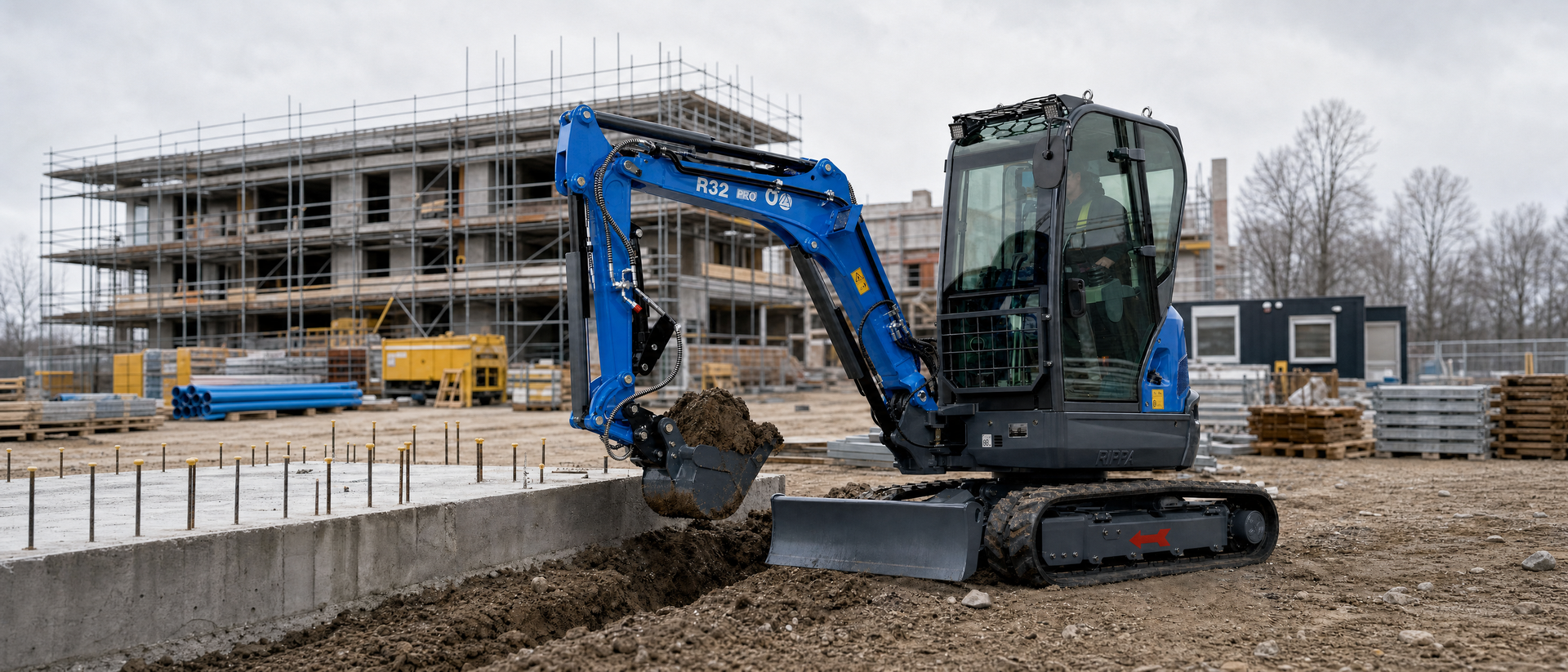.png)
A mini excavator lasts many thousand operating hours if the maintenance is right. Most expensive breakdowns are not caused by wear but by small things: too little hydraulic oil, a track that is too loose, a clogged air filter. This checklist shows you what to check before every job, what is due weekly and what comes around once a year.
- Before every job: oil levels, leaks under the machine, track tension, greasing the pins. Five minutes that prevent most damage.
- Every 50 operating hours: clean the air filter, retighten bolts on the undercarriage, check hydraulic hoses for chafing.
- Every 250 operating hours: change engine oil and oil filter, replace the fuel filter.
- Yearly or every 500 operating hours: change hydraulic oil and filter, check the coolant, have the valve clearance adjusted by a workshop.
The intervals in this article are common reference values for mini excavators of this size class. The quantities, oil grades and change intervals that apply to your machine are stated in the operating manual supplied with it. In case of doubt, the operating manual always takes precedence.
- Why maintenance decides cover and service life
- Daily: five minutes before you start
- Every 50 operating hours
- Every 250 operating hours
- Yearly or every 500 operating hours
- Fill quantities of the Rippa models
- Checking track tension correctly
- Winter and longer idle periods
- Which parts to keep in stock
- Frequently asked questions
Why maintenance decides cover and service life
A mini excavator works under conditions that put a strain on any machine: dust, vibration, changing loads and often wet ground. The components are built for that — but only as long as they get clean oil, enough grease and no foreign objects running along in the undercarriage.
There is a formal point on top of that: damage caused by missed or faulty maintenance is excluded from cover. That applies at Rippa Europe as it does with every other manufacturer. What our cover includes and what it does not is set out in detail on that page.
Note the date, the operating hours and the work carried out — a simple notebook in the tool box is enough. In a claim this is your evidence, and when you sell the machine a complete maintenance record noticeably raises the price.
Daily: five minutes before you start
Carry out this check on a cold machine on level ground, before you start the engine. It takes five minutes and catches the bulk of all expensive damage.
- Engine oil level on the dipstick, top up if needed.
- Hydraulic oil level at the sight glass. The boom has to rest on the ground, otherwise the glass shows a false level.
- Coolant in the expansion tank — on all water-cooled models, that is all of them except the R10 ECO.
- A look underneath: oil stains on the ground are the first sign of a leaking line or a worn cylinder seal.
- Search the undercarriage: remove stones, wire or root remains between track and rollers. Foreign objects wear the undercarriage faster than any digging work.
- Track tension, see the separate section.
- Greasing: all pins and bushings on boom, dipper arm and bucket. With daily use this belongs in the daily routine, and in continuous work with a breaker even more often.
- Controls: check the safety lever, the emergency stop and the lights.
Every 50 operating hours
Depending on the work that is roughly once a week. In very dusty jobs — demolition, dry sandy ground, milling work — the filter tasks in particular come around considerably sooner.
- Air filter: remove it and blow it out from the inside with dry compressed air. Do not wash it and do not blow from the outside, that drives the dust into the filter medium.
- Radiator and fan grille: clear dust and grass remains. A clogged radiator is the most common cause of overheating.
- Bolted joints on the undercarriage, the rollers and the counterweight: check that they are tight.
- Hydraulic hoses: look for chafing, cracks and damp spots at the fittings.
- Battery: check the terminals for corrosion, tighten the clamps.
- Bucket teeth and cutting edges: check for wear. Worn teeth cost fuel and time.
Every 250 operating hours
This is where maintenance starts to need materials. Put filters and oil ready beforehand and the job is done in one to two hours.
- Change engine oil and oil filter. Drain the oil while the engine is hand-warm, then it runs out completely.
- Replace the fuel filter and drain the water separator if one is fitted.
- V-belt: check tension and look for cracks.
- Hydraulic oil: check the level and judge the condition. Milky means water in the system, dark and smelling means it has overheated. Both are a case for the workshop.
- Undercarriage: readjust the track tension, check the rollers for play.
Yearly or every 500 operating hours
The big appointment. Anyone using the machine commercially often reaches 500 hours within a few months — then the hour meter counts, not the calendar.
- Change hydraulic oil and hydraulic filter. Clean hydraulic oil is the single most important factor for the service life of pump and control valve.
- Coolant: check it, renew it if needed, measure the antifreeze.
- Valve clearance: have it adjusted — that is a job for the workshop.
- Cylinder seals: check the hydraulic cylinders for oil escaping.
- Electrics: search the wiring harness for chafing, check the connectors for corrosion.
- Quick coupler and attachments: check for play and for cracks in the welds.
Fill quantities of the Rippa models
These values come from the technical data of each machine. They help you plan how much oil to put ready for a change. For the exact quantities and oil grades, see the operating manual.
| Model | Engine | Cooling | Fuel tank | Hydraulic tank |
|---|---|---|---|---|
| R06 | Kubota Z482 | Water | 5 l | — |
| R10 ECO | Ligong 192F | Air | 8.5 l | 12.5 l |
| R13 PRO | Kubota D722 | Water | 10 l | 12 l |
| R15 ECO | Kubota D722 | Water | 20 l | 22 l |
| R18 PRO | Kubota D902 | Water | 22 l | 15 l |
| R22 PRO | Kubota D1105 | Water | 28 l | 37 l |
| R32 PRO | Kubota V1505 | Water | 45 l | 40 l |
The R10 ECO is the only model with an air-cooled engine. It needs no coolant check, but the cooling fins on the cylinder have to stay clean.
Checking track tension correctly
A track that is too loose jumps off under load and damages rollers and track links in the process. A track that is too tight puts a permanent strain on the travel drive and the tensioner and wears out both early. Either costs more than the five minutes the check takes.
This is how you do it: carefully lift one side of the machine with the boom and the blade until the track hangs free. Measure the sag between roller and track in the middle of the undercarriage. The permitted value is stated in the operating manual and is usually a few centimetres on machines of this size.
Rippa uses two designs depending on the model:
- Mechanical tensioner — on the R06, R10 ECO, R13 PRO and R15 ECO. Adjustment is made with a tensioning screw.
- Grease tensioner — on the R18 PRO, R22 PRO and R32 PRO. Here grease is pressed into the tensioning cylinder through a valve.
The tensioning cylinder is under high pressure. Open the valve slowly and by no more than one turn, and do not stand in front of the opening. Grease escaping under pressure can cause serious injury. If in doubt, leave the release to the workshop.
Winter and longer idle periods
Most starting problems in spring do not come from the machine but from the way it was stored over the winter.
- Fill the tank. A full tank leaves no room for air in which condensation can form.
- Use winter diesel and watch the cold resistance during a long frost. Summer diesel waxes below zero and blocks the filter.
- Disconnect the battery or put it on a trickle charger. A deeply discharged battery rarely survives the winter.
- Measure the antifreeze before the first night of frost.
- Clean the undercarriage. Frozen clay between track and roller tears track links out at the first move.
- Rest the boom on the ground and park with the piston rods retracted as far as possible — bare rods corrode.
- Store it dry or at least cover it, but do not wrap the cover airtight.
Which parts to keep in stock
When a machine is in service, every day of standstill costs money. With a small selection of parts on the shelf you bridge most unplanned stops yourself.
- Engine oil filter and fuel filter — the parts with the shortest change interval.
- Air filter, at least one spare element for dusty jobs.
- Hydraulic filter for the yearly change.
- A set of bucket teeth and the matching pins.
- Seal kits for the hydraulic cylinders under the heaviest load.
- One spare hydraulic line in the length that is loaded most often.
All parts are sorted by machine model so that nothing unsuitable ends up in the basket: go to the spare parts.
Parts for your machine
Common wear and spare parts are held in our warehouse in Europe and go out at short notice. If you are not sure which part fits your machine, give us the model and the order number — we will find it for you.
Frequently asked questions
Sources and further reading
- Operating manual of the respective machine (supplied with the machine) — binding for intervals, quantities and oil grades.
- Technical data of the models on the respective product page in the shop.
- Rippa Europe cover conditions
- Guide: transporting a mini excavator
- Frequently asked questions on purchase, delivery and service